

Private equity firms comparing portfolio monitoring software in 2026 choose among Carta, Chronograph, iLEVEL from S&P Global, Allvue, eFront, Dynamo, Cobalt, 73 Strings, V7 Go, Hebbia, and Saphenia. Carta through Cobalt are monitoring platforms that collect, standardize, and store portfolio data, while 73 Strings, V7 Go, Hebbia, and Saphenia are review tools that work on the figures in the performance pack. If your firm needs a system of record for portfolio-company data, start with a platform. Add a review tool when your analysts rebuild the performance pack by hand every quarter, reconciling reports and chasing missing figures before the investment committee meets.
I founded Saphenia, which builds decision logic for enterprise agents. Saphenia publishes this list and appears on it. The numbering is for reference and carries no rank.
What matters most when you choose
- Monitoring platforms hold the data. The review work sits on top of them: reconciling two reports, handling a changed KPI definition, flagging a missing figure, and recording who approved what.
- The Institutional Limited Partners Association (ILPA) has opened a refresh of their Portfolio Company Metrics Template for public comment (ILPA homepage, October 2026).
- With Saphenia, every figure has one of four outcomes: fulfilled with proof, refused by a rule, a named gap, or reserved for a human.
- To compare a vendor with an internal build, run both on the same quarter's documents with a planted disagreement, a changed definition, and a missing report.
At a glance
| # | Option | Layer | Best for | What it is, in the vendor's terms | Pricing |
|---|---|---|---|---|---|
| 1 | Carta | Monitoring platform | PE and VC firms that want data collection and fund forecasting from one vendor | Data Collection, Fund Forecasting, and Carta MCP | No price on the page reviewed |
| 2 | Chronograph | Monitoring platform | GPs and LPs across buyout, growth, venture, infrastructure, and private credit | Cloud portfolio monitoring, valuation, reporting, and data warehousing | No price on the page reviewed |
| 3 | iLEVEL (S&P Global) | Monitoring platform | GPs, LPs, and funds of funds that want modular monitoring and valuation | Private markets software for portfolio monitoring, in modules | No price on the page reviewed |
| 4 | Allvue | Monitoring platform | Managers running PE, private credit, and CLOs on one platform | Alternative investment software for the full fund lifecycle | No price on the page reviewed |
| 5 | eFront (BlackRock) | Monitoring platform | Asset owners and LP teams that connect diligence, manager selection, and monitoring | Alternative investment management platform | No price on the page reviewed |
| 6 | Dynamo | Monitoring platform | Firms that want CRM, investor relations, and monitoring in one configurable platform | Front-to-back office platform for alternative investments | No price on the page reviewed |
| 7 | Cobalt (Hamilton Lane) | Monitoring platform | LPs and allocators that want benchmarking and forecasting beside monitoring | Private markets software with operational support | No price on the page reviewed |
| 8 | 73 Strings | Review tool | Managers whose review runs through to the valuation mark | Data and valuation infrastructure for private markets | No price on the page reviewed |
| 9 | V7 Go | Review tool | Investment and insurance firms that want configurable document workflows | Document workflows for finance, insurance, and enterprise | No price on the page reviewed |
| 10 | Hebbia | Review tool | Investment, banking, and legal teams doing research across filings and data providers | Document and financial-data analysis for finance | No price on the page reviewed |
| 11 | Saphenia | Review tool | PE firms that want an agent running the quarterly review on their own rules | Decision logic for enterprise agents | Quoted per deployment |
How we chose this list
Five rules set what went into the list and how each entry reads.
- Each product appears on the pages buyers read when they compare portfolio monitoring software, or works directly on portfolio-company reports.
- Each entry comes from the vendor's own pages, read in October 2026.
- Each entry carries the same five fields in the same order, from Best for to Pricing, followed by a fit line, Strengths, and Considerations.
- Customer counts, assets under management, and performance claims stay out, because a list one vendor publishes is the wrong place to carry another vendor's numbers.
- Entries are grouped by layer.
What turns portfolio-company reports into a reviewable performance pack
A performance pack becomes reviewable when every figure carries four things: the document and page it came from, the definition behind it, the period it covers, and the person who approved it. Clean reports are the easy case, while three hard cases test the pack: two reports that disagree on a figure, a KPI whose definition changed between periods, and a fact that never arrived. Miss any of them and the investment committee sees a figure nobody can trace.
ILPA's templates set a shared reference for which metrics to report, so read the refresh on the ILPA site before you settle your own definitions. Two walkthroughs cover the hard cases: when portfolio-company reports disagree, and changed KPI definitions and missing facts. The approval step has its own article, who signs off a figure. For the full process, see how to prepare a portfolio performance review.
Monitoring platforms collect, standardize, and store portfolio data
Each platform below holds your firm's portfolio-company data for reporting to the investment team and to LPs.
1. Carta
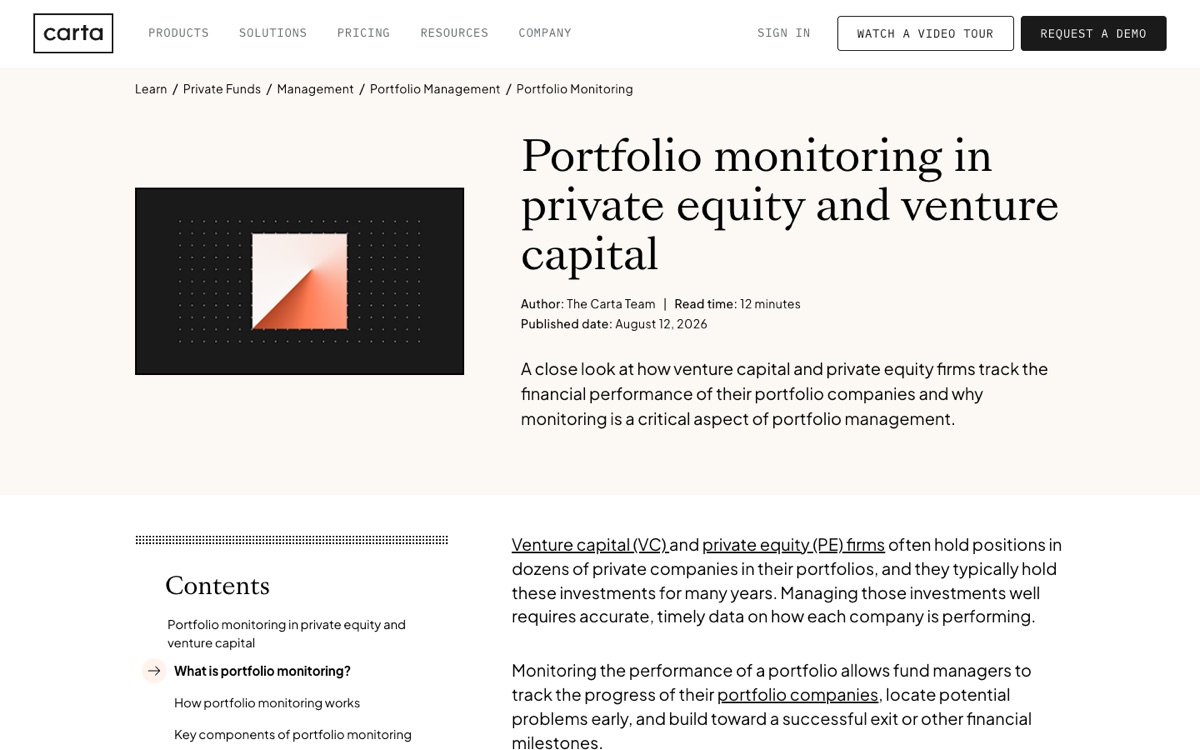
- Best for: Private equity and venture capital firms that want portfolio data collection and fund forecasting from one vendor.
- What it is: Carta's guide to portfolio monitoring (August 2026) presents three Carta products for the work: Data Collection, Fund Forecasting, and Carta MCP.
- Who it says it serves: Funds in private equity and venture capital, the two audiences the guide addresses.
- Extraction, tracing, and review on the page: The guide covers fund metrics, company metrics, benchmarks, reporting, and exit monitoring. It names fragmented data, data quality, delayed visibility, and manual processes as the problems.
- Pricing: No price on the page reviewed.
Carta keeps company metrics and fund-level forecasts in one system.
- Strengths: The guide lists different definitions of the same metric among the problems the products address.
- Considerations: Ask Carta to show how they reconcile a metric that two portfolio companies define differently.
2. Chronograph
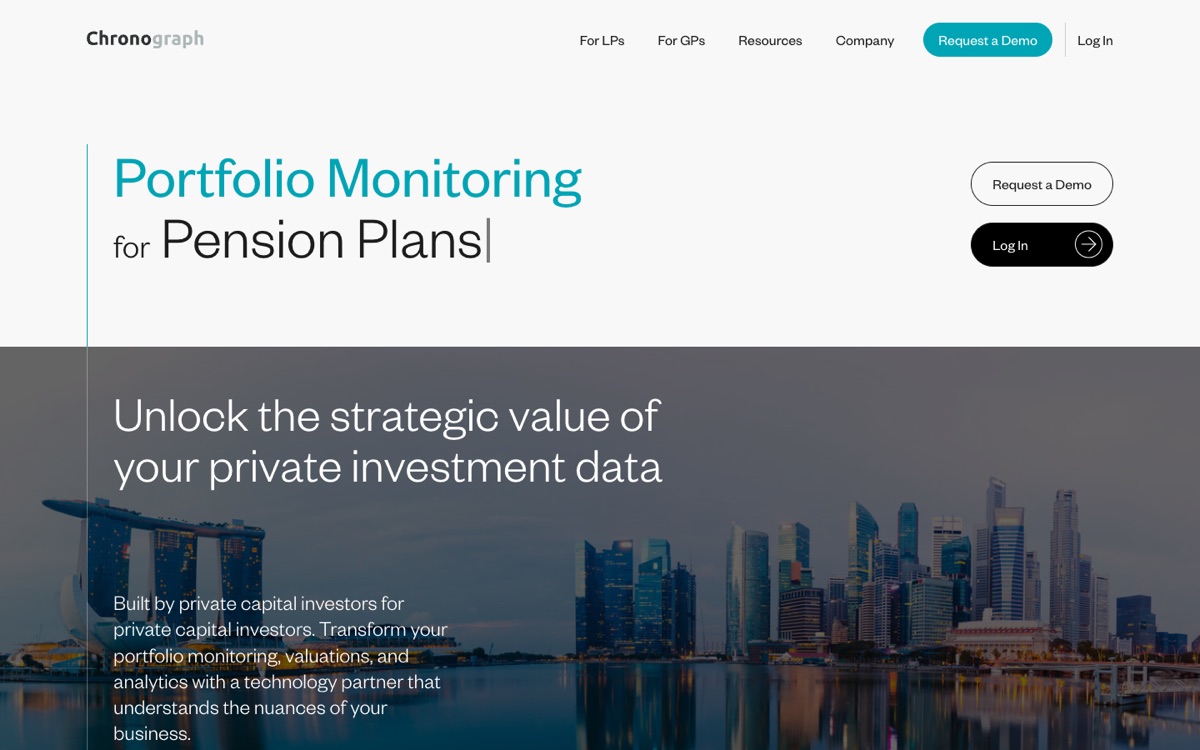
- Best for: GPs and LPs across buyout, growth, venture, infrastructure, and private credit that want collection, valuation, and reporting on one cloud platform.
- What it is: Chronograph's homepage says Chronograph GP automates portfolio company data collection, analytics, valuation, reporting, and data warehousing for investors.
- Who it says it serves: GPs across buyout, growth, venture, infrastructure, real assets, and private credit. LPs, including funds of funds, pensions, sovereign wealth funds, insurers, endowments, and family offices.
- Extraction, tracing, and review on the page: The page lists AI enablement, MCP connectors, semantic search, and integrations with third-party assistants, and says the product can automate constituent reporting with validated data.
- Pricing: No price on the page reviewed.
Chronograph fits a GP or LP that wants one cloud product from data collection through valuation and reporting.
- Strengths: One product covers collection, valuation, reporting, and a data warehouse with APIs.
- Considerations: Ask Chronograph to trace one reported figure to its source page and show where an approval is recorded.
3. iLEVEL (S&P Global)
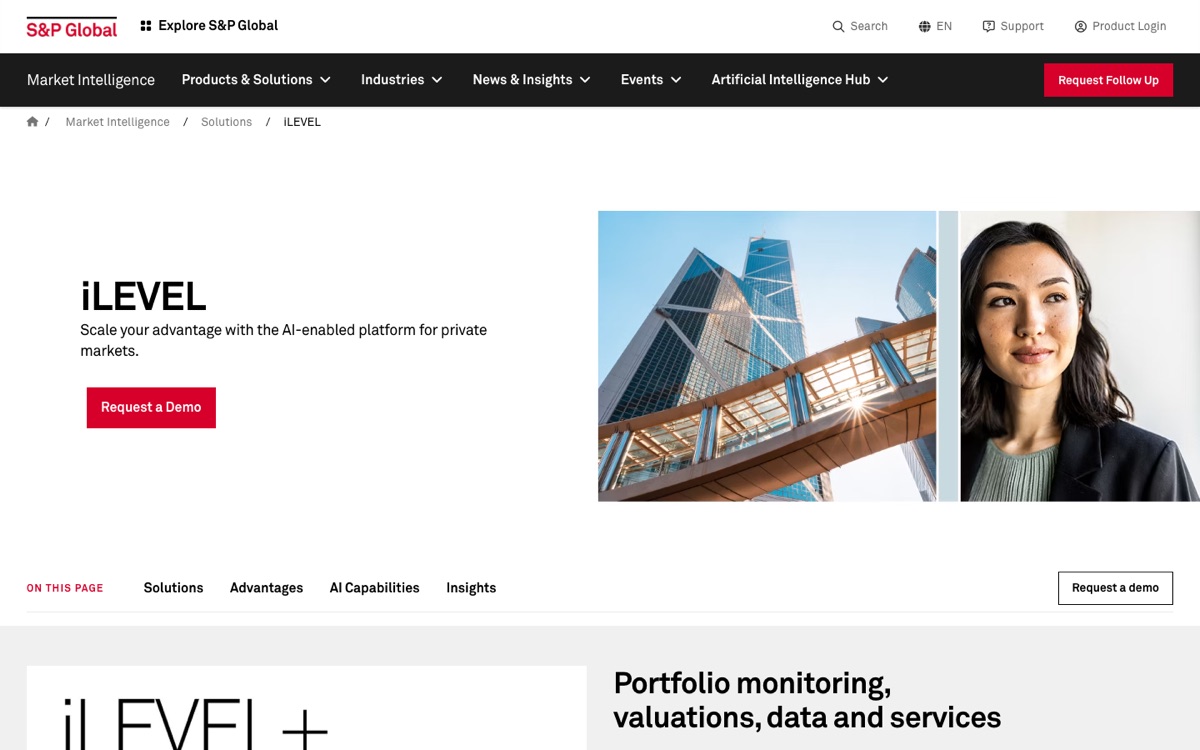
- Best for: GPs, LPs, and funds of funds that want modular monitoring and valuation, with outsourced data collection available.
- What it is: S&P Global describes iLEVEL as private markets software for portfolio monitoring. Its modules cover valuations, data and performance analytics, and outsourced data collection. Each module integrates with existing software.
- Who it says it serves: General partners, limited partners, and funds of funds.
- Extraction, tracing, and review on the page: The page calls the platform AI-enabled and describes valuations as timely and transparent.
- Pricing: No price on the page reviewed.
iLEVEL suits a firm adding monitoring, one module at a time, beside software they already run.
- Strengths: Outsourced data collection is offered as a service alongside the software.
- Considerations: Ask S&P Global to show tracing and approval in a live private equity review.
4. Allvue
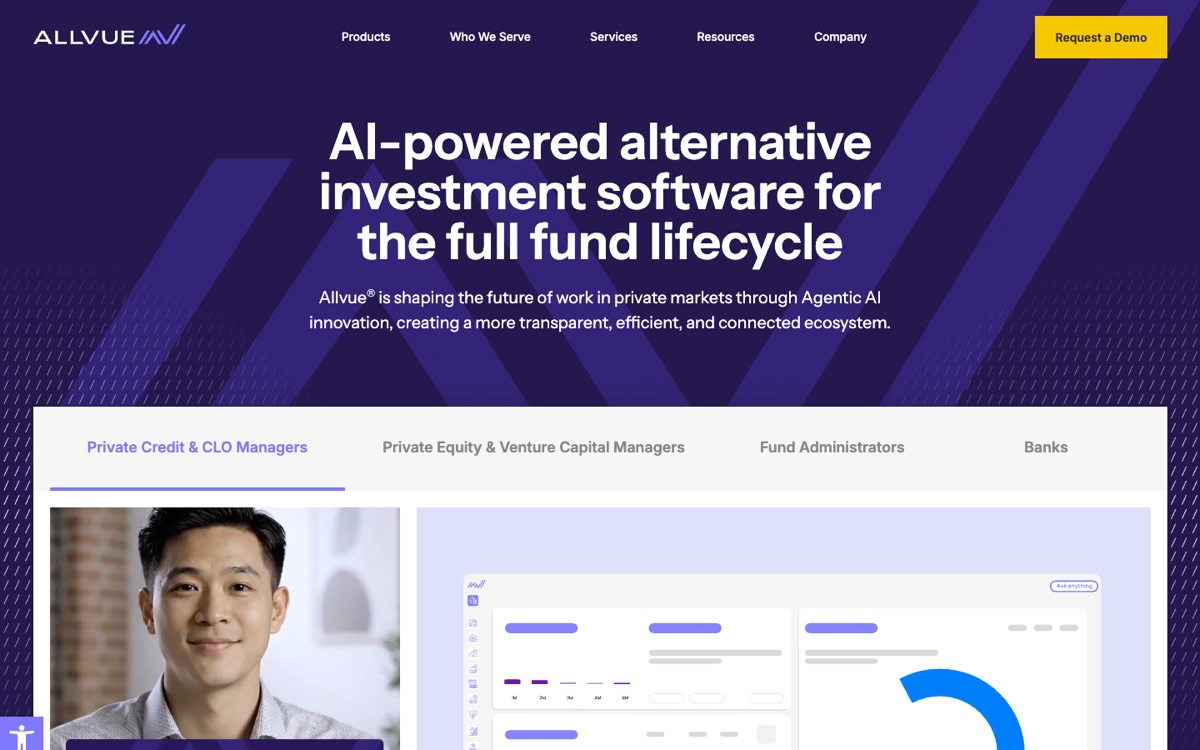
- Best for: Private equity, private credit, and CLO managers that want accounting, investor reporting, and portfolio monitoring on one platform.
- What it is: The Allvue homepage describes the product as AI-powered alternative investment software for the full fund lifecycle.
- Who it says it serves: General partners, credit asset managers, fund administrators, banks for asset-based lending, and insurers, across private equity, venture capital, private debt, CLOs, and funds of funds.
- Extraction, tracing, and review on the page: Document IQ extracts data from financials, credit agreements, and capital calls. The page says its agentic workflows automate routine tasks and bring people in for exceptions or approvals. Andi Insights answers natural-language queries over governed financial data.
- Pricing: No price on the page reviewed.
Allvue is the fit when fund accounting and portfolio monitoring should share one data set.
- Strengths: The page names exceptions and approvals as the part people handle.
- Considerations: Ask Allvue how an extracted figure links back to its document and page.
5. eFront (BlackRock)
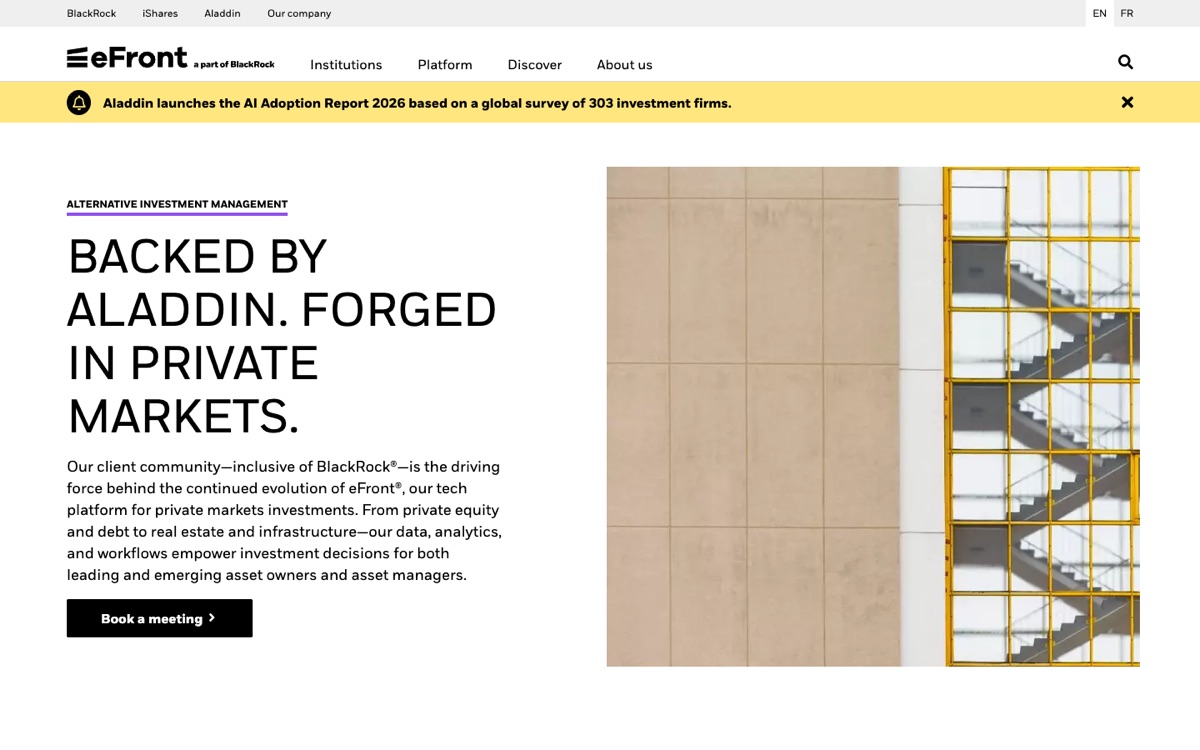
- Best for: Asset owners and LP teams that want due diligence, manager selection, and portfolio monitoring connected, with Preqin data inside.
- What it is: An alternative investment management platform. eFront Insight connects due diligence, manager selection, and portfolio monitoring.
- Who it says it serves: Asset managers, asset servicers, funds of funds, and asset owners such as pension funds, endowments, insurers, banks, and family offices.
- Extraction, tracing, and review on the page: The page introduces eFront Copilot and GenAI and speaks of connected data, trusted workflows, and human judgment. It says servicers can strengthen auditability.
- Pricing: No price on the page reviewed.
eFront fits the LP side, where manager selection and monitoring feed the same allocation decision.
- Strengths: eFront puts market data next to the firm's own portfolio data.
- Considerations: Ask where a reviewer's approval of a figure is recorded, and how it carries into the next period.
6. Dynamo
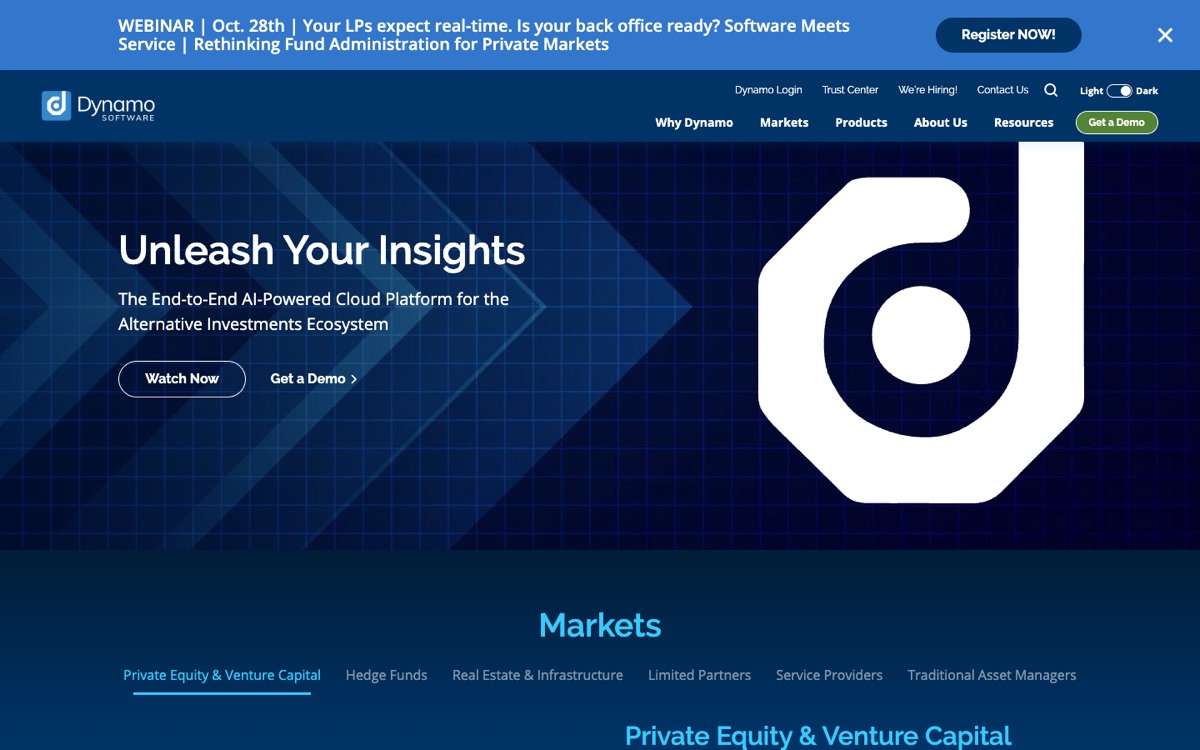
- Best for: Firms that want CRM, deals, investor relations, fundraising, portfolio monitoring, and fund accounting in one configurable platform.
- What it is: Dynamo describes a configurable, integrated, AI-powered platform built for the front-to-back office needs of GPs, LPs, and service providers.
- Who it says it serves: GPs, LPs, and service providers, including private equity, hedge funds, funds of funds, and institutional investors.
- Extraction, tracing, and review on the page: The page names DynamoAI for GPs and DynamoAI for LPs. Its private equity and venture section promises to monitor and analyze portfolio performance.
- Pricing: No price on the page reviewed.
With Dynamo, the deal team, investor relations, and finance work in one configured system.
- Strengths: Modules cover the front office through the back office.
- Considerations: The page doesn't describe how portfolio-company reports come in, so ask Dynamo to demonstrate it.
7. Cobalt (Hamilton Lane)
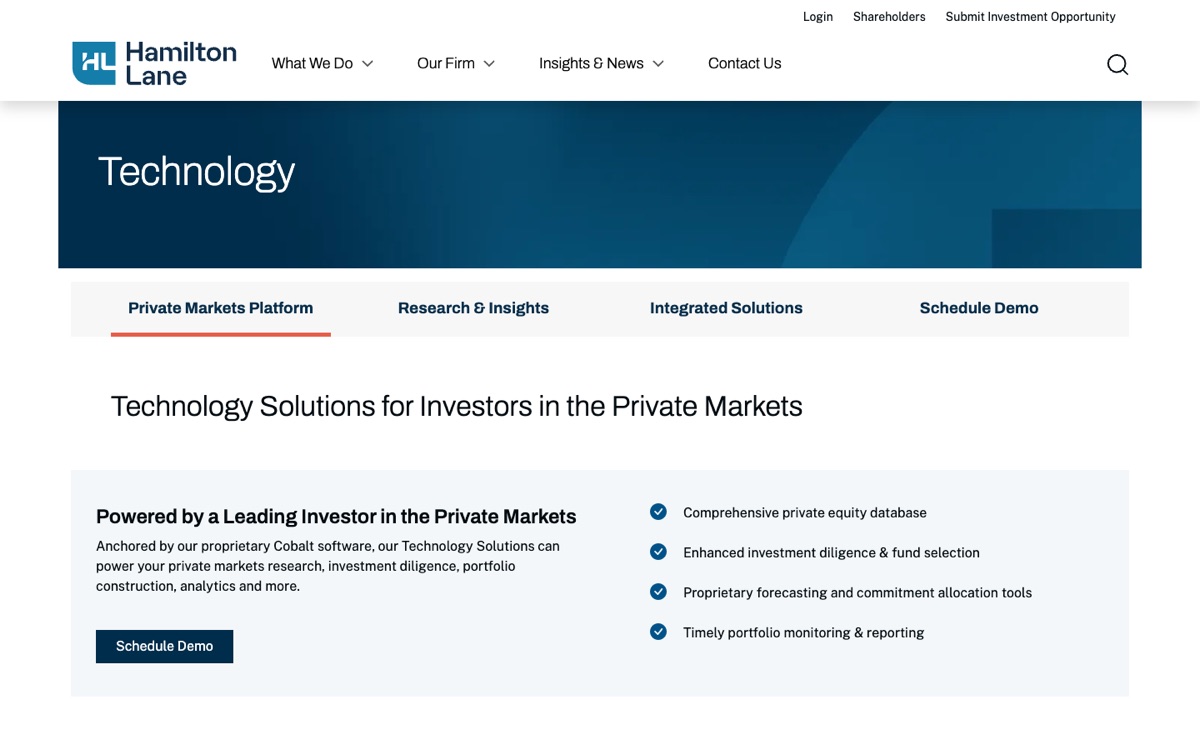
- Best for: LPs and allocators that want benchmarking and cash-flow forecasting beside monitoring, with operational support from the vendor.
- What it is: Hamilton Lane's private markets software, which the page says can power private markets research, investment diligence, portfolio construction, and analytics. Cobalt offers portfolio monitoring and reporting alongside a private equity database. Its tools also cover benchmarking, forecasting, and commitment allocation.
- Who it says it serves: Investors in private markets. The demo form lists GPs, LPs, private equity firms, insurers, financial institutions, pensions, endowments, and family offices.
- Extraction, tracing, and review on the page: The page pairs the reporting and analytics software with operational support from Hamilton Lane's team and mentions transparent fund-level and deal-level benchmarks.
- Pricing: No price on the page reviewed.
Cobalt suits an allocator that benchmarks and forecasts across many funds.
- Strengths: Benchmarks and a cash-flow model come in the same software as monitoring.
- Considerations: Ask Hamilton Lane how portfolio-company reports enter the platform and who checks them.
Review tools work on the figures inside the pack
The four tools below work on the source documents behind each figure.
8. 73 Strings
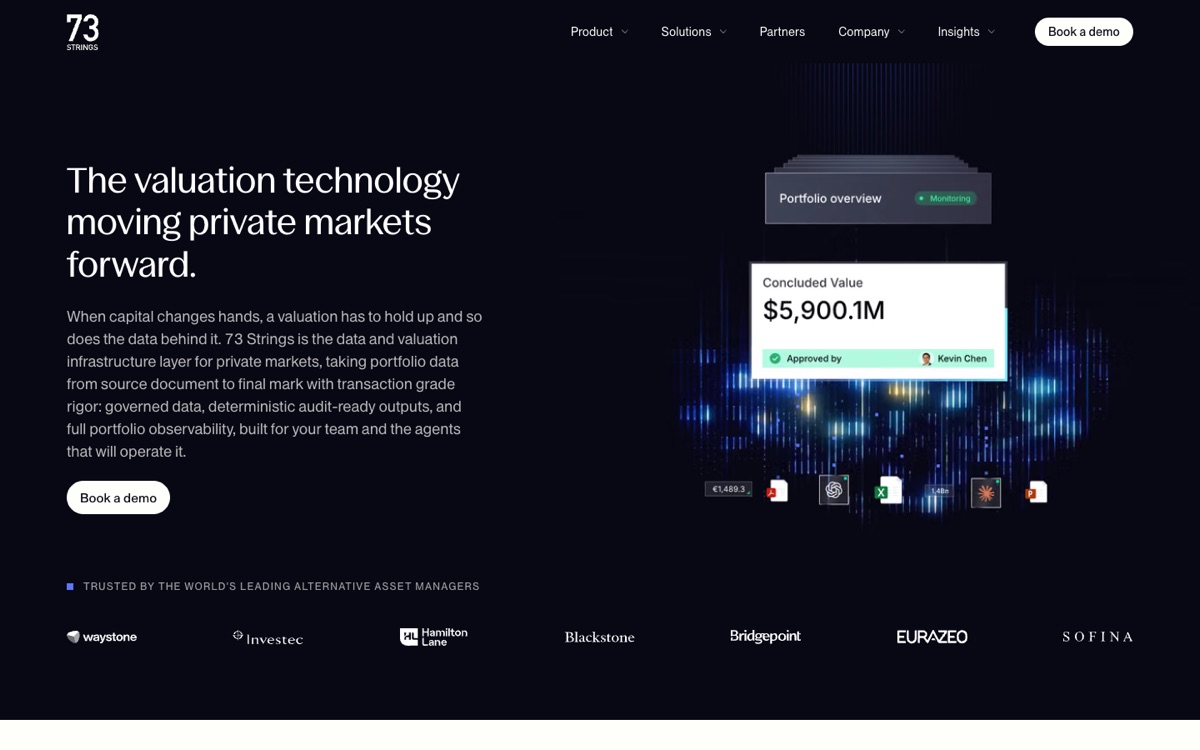
- Best for: Managers whose review runs through to the valuation mark, across private equity, private credit, venture capital, and infrastructure.
- What it is: The 73 Strings homepage calls the platform the data and valuation infrastructure layer for private markets. It takes portfolio data from source document to final mark through three products: 73 Extract, 73 Monitor, and 73 Value.
- Who it says it serves: Alternative asset managers in multi-strategy, private equity and growth, private credit, venture capital, and infrastructure.
- Extraction, tracing, and review on the page: The page describes agentic extraction, monitoring, and valuation with human-in-the-loop validation, full traceability, and outputs ready for an auditor.
- Pricing: No price on the page reviewed.
73 Strings suits a firm where the quarterly review and the valuation are the same piece of work.
- Strengths: Full traceability and human-in-the-loop validation are part of the product, according to the homepage.
- Considerations: Ask what happens to a figure when two source documents disagree, and whether a validator's correction still applies next quarter.
9. V7 Go
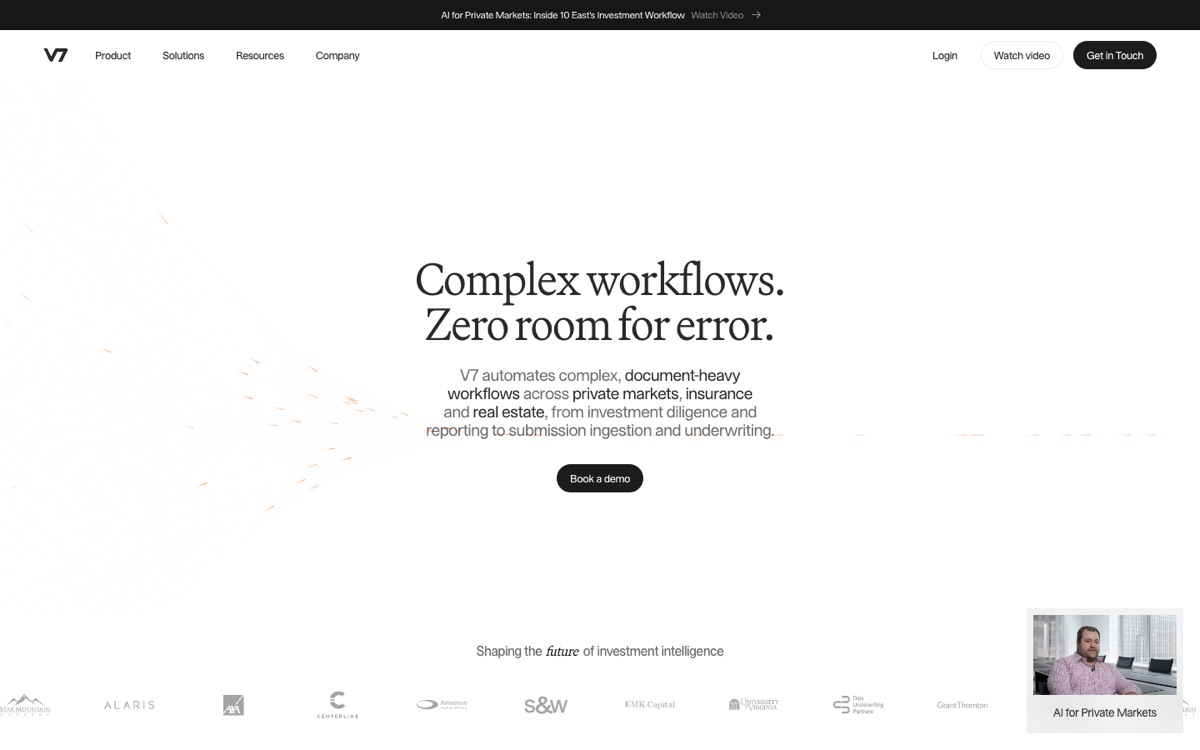
- Best for: Private markets, insurance, and real estate investment firms that want configurable agents across document-heavy work, from diligence to portfolio reporting.
- What it is: V7 Go offers document workflows for finance, insurance, and enterprise work, with prebuilt agents, document generation, and integrations.
- Who it says it serves: Private markets, insurance, and real estate investment firms. For private equity it lists deal screening, due diligence, IC memos, portfolio reporting and monitoring, LPA analysis, and DDQ completion.
- Extraction, tracing, and review on the page: The page lists audit logs across every workflow, fine-grained access controls, and no training on customer data.
- Pricing: No price on the page reviewed.
V7 Go makes sense when portfolio reporting is one of several document workflows a firm wants to run in one tool.
- Strengths: Audit logs run across every workflow.
- Considerations: Ask V7 to show where your firm's rules and sign-off steps are set inside a workflow.
10. Hebbia

- Best for: Investment, banking, and legal teams running research and document analysis across filings and financial data providers.
- What it is: Hebbia sells AI built for finance through two products, Max and Matrix, and promises documents and financial data in one place.
- Who it says it serves: Investors, bankers, lawyers, consultants, and Fortune 500 companies.
- Extraction, tracing, and review on the page: The demo matrix lists source documents in their own column and shows the filing or data provider behind each answer. It marks missing items as not disclosed.
- Pricing: No price on the page reviewed.
Hebbia suits research-heavy work across many documents at once.
- Strengths: Each cell in the demo shows its basis and flags any item the sources do not disclose.
- Considerations: The homepage demo covers sell-side and M&A origination work. Request one built on a portfolio-company review.
11. Saphenia
- Best for: Private equity firms that want an agent to run the recurring portfolio-company review on their own rules.
- What it is: Saphenia is decision logic for enterprise agents. Saphenia captures the terms, rules, and data sources a firm uses for one recurring decision and enforces that logic before the answer goes out. Each workstream is set up one decision at a time.
- Who it says it serves: Private equity, financial services, and pharma.
- Extraction, tracing, and review on the page: Every claim in the agent's output is checked before the answer goes out. Each figure ends in one of the four outcomes shown in the worked example below. Proof carries the facts, the rule, its version, and the date. Each fact also carries the period in which it was valid.
- Pricing: Quoted per deployment. The cost is set by the size and complexity of the data, the number of decisions, and whether a bespoke agent or integrations are needed. See how Saphenia is priced.
Saphenia suits a firm that already collects portfolio data in a platform or a shared store.
- Strengths: A refusal names the rule that stopped the figure, and a gap names what is missing.
- Considerations: ISO 27001 and SOC 2 are both in progress, with ISO 27001 expected first. Saphenia starts with one workstream, and your firm chooses which decision goes first.
A worked example: one portfolio company, four outcomes
Take Northfield Packaging, a made-up portfolio company, and their third-quarter review. Every name, figure, and rule in this example is invented. Here is how four lines of that review resolve when each is checked against the firm's rules.
- Revenue: fulfilled with proof. The management accounts show €48.2m on page 4, while the board deck shows €47.5m on slide 6. The firm's source rule says reviewed management accounts outrank the board deck for revenue, so the pack reports €48.2m with the evidence (management accounts, page 4), the rule and its version, and the date. The same rule keeps the board deck's €47.5m on the record beside the reported figure.
- Adjusted EBITDA margin against the prior quarter: refused by a rule. Northfield changed their adjusted EBITDA definition this quarter to exclude restructuring costs, and the firm's rule requires a restated prior period before any period-over-period comparison across a definition change. So the pack withholds the comparison and names that rule.
- Net debt and leverage: a named gap. The quarter's covenant compliance certificate is missing from the upload, so the pack states that the certificate is missing and holds net debt and leverage until it arrives.
- The valuation mark: reserved for a human. Revenue is 11 percent below budget, past the firm's 10 percent threshold for partner review, so the pack sends the mark to the deal partner with the figures and evidence attached.
Then the deal partner looks into the revenue disagreement and finds the €0.7m gap is revenue booked in the last week of the quarter, after the board deck went out. The partner approves a correction for Northfield: a board deck dated before quarter-end is marked preliminary, and the closed management accounts set revenue. That correction becomes a rule, and the fourth-quarter review follows it.
How to compare a vendor's review output with an internal Databricks or Azure build
To keep the comparison fair, run the vendor's system and your internal build side by side, and score each one at every step below.
- Use the same inputs. Take one recent quarter and every portfolio company's reports as they arrived, with their gaps and inconsistencies intact.
- Plant three hard cases. Include two reports that disagree on one figure, one KPI whose definition changed, and one missing document, then record what each system returns for every case. A planted case that comes back with no flag is the failure to watch for.
- Trace five figures to their pages. Each system should return the document, the page, and the passage for every figure.
- Change a rule mid-test. Move a materiality threshold and count the hours and people each system needs to apply the change. Then check that earlier reviews still show the rule version they used.
- Correct one output. Run the review again and check whether the correction holds without anyone editing a prompt.
- Price the maintenance. Ask who keeps the internal build current when policies change and the pilot team moves on. For that full cost, see build or buy AI agents.
- Ask where the rules and records live. Then confirm you can export them.
In Saphenia, hard rules pass or fail outright, and preferences apply by default with every override recorded. To score a pilot step by step, see how to evaluate a portfolio review pilot.
What to ask a vendor before adding a second workstream
Before you extend portfolio reporting to a second workstream, such as LP reporting or covenant monitoring, ask what carries over from the portfolio review and what the new workstream costs. The six questions below test both.
- Which definitions, source rules, and approved corrections from the portfolio review does the second workstream reuse?
- Who changes a rule, and how does the change show up as a new version in every output that used it?
- How is the second workstream priced: per workstream, by data volume, or per seat?
- How long does the second workstream take to reach its first live decision?
- Which calls in the new workstream stay with a person, and where is each of those calls recorded?
- Where does the new workstream run, and what leaves with you if you change vendors?
At Saphenia, each workstream is set up as its own decision, and every decision reads from one shared record of everything Saphenia builds from your firm's data. A second workstream reuses the definitions and corrections the first one recorded there. Each added workstream changes the quote.
Saphenia works alongside the monitoring platform or shared data store where the collected data lives. Saphenia runs the review on that data and on the source reports behind it. For how an approved correction becomes a rule that every later review follows, see deterministic AI agents.
Saphenia builds the decision logic in days, and the first decision ships in weeks. It runs in Saphenia's cloud or in your firm's own cloud and works with any model provider. A firm that leaves Saphenia takes everything built from their data with them. Both hosting options are covered in hosting and data ownership.
How to choose, by situation
- Choose Carta if your firm runs both private equity and venture funds and wants data collection and fund forecasting from one vendor.
- Choose Chronograph if you want collection, valuation, reporting, and a data warehouse on one cloud platform across buyout, growth, venture, infrastructure, and private credit.
- Choose iLEVEL if you want monitoring and valuation as modules beside software you already run, with outsourced data collection.
- Choose Allvue if fund accounting, investor reporting, and monitoring should share one platform across private equity and private credit.
- Choose eFront if you sit on the LP side and want diligence, manager selection, and monitoring connected.
- Choose Dynamo if you want CRM, investor relations, fundraising, and monitoring configured in one system.
- Choose Cobalt if benchmarking and cash-flow forecasting matter as much as monitoring, and you want the vendor's operational support.
- Choose 73 Strings if your quarterly review and your valuation mark are one process.
- Choose V7 Go if you want configurable document workflows across diligence and reporting.
- Choose Hebbia if your team does research across filings and data providers.
- Choose Saphenia if you want an agent to run the portfolio-company review on your firm's rules, with every approved correction kept for the next quarter.
FAQ
Does a private equity firm need both a monitoring platform and a review tool?
A private equity firm that wants agents on the quarterly review needs a review tool for the figures and a place that holds the collected data. That place can be a monitoring platform or a shared data store. The monitoring platforms on this list are Carta, Chronograph, iLEVEL, Allvue, eFront, Dynamo, and Cobalt, and the review tools are 73 Strings, V7 Go, Hebbia, and Saphenia.
Does Saphenia train on portfolio data?
Saphenia never trains on customer data. The product extracts, structures, and enforces the firm's decision logic, and is taught through corrections the firm's experts approve. Everything built from your data belongs to you, and you can take it with you.
Is Saphenia certified for SOC 2 or ISO 27001?
Saphenia's SOC 2 and ISO 27001 certifications are both in progress, with ISO 27001 expected first. For hosting, data ownership, and deployment options, see the article on hosting and data ownership.
Sources
- Institutional Limited Partners Association homepage, ILPA
- Portfolio monitoring guide, Carta
- Chronograph homepage, Chronograph
- iLEVEL product page, S&P Global Market Intelligence
- Allvue homepage, Allvue Systems
- eFront homepage, eFront (BlackRock)
- Dynamo homepage, Dynamo Software
- Cobalt (Technology Solutions), Hamilton Lane
- 73 Strings homepage, 73 Strings
- V7 Go product page, V7 Labs
- Hebbia homepage, Hebbia
 Nathaniel Sibi
 Charlotte Werger
